
Prose Archive
a critical self-curiosity and reflection

I remember the way I would write before 2021. Amidst one of the most isolating periods of my little life, I somehow wrote without withholding, without so much heaviness.
In the opening page of the first anthology I created, Grouping Words I, I introduce myself and the intention here,
“In all honesty, words are my only escape. Devouring them with my eyes, choosing them with my pen. It’s a revelatory experience for me… But I would appreciate if the reader look beyond the format, and simply just at the grouping of words, and what that entails…”
I weave together a collection of prose that is messy and intimate with the self, the body, violation, mourning and connection. I write these pieces as a fifteen, sixteen, and seventeen year old who decided to give voice to the way their soul floats, and how it always seems to drive against the grain. And then, I’m nineteen: I submit the collection for publishing and am sent back a contract within six months. I cry with joy. I re-read the collection, cry some more. There is no way that I could publish this as is, I think (at twenty). How embarrassing, I think (at twenty-one).
I was right at twenty and twenty-one, I think. But there are parts which I look at today and am curious about exploring. I want to explore selected pieces in conjunction with each other, and try creating a new grouping of words using these groupings to picture exactly where my curiosities lie.
Retrospect is helpful in that it affords us the time to reflect, for our perspectives to develop over time. I don’t need to deconstruct the prose in Grouping Words I to know how performative I used to be before I had internally accepted and embraced my gender-transition. But, listen to this -
hi
my name is [X]
I have short and curly brown hair and a wide smile, I have brown eyes and people like this convention; a lot of people like my brown hair & brown eyes, and rose cheeks (my disguise).
a. Naming, Redacting, and Re-naming
I have redacted the name in this article, I no longer identify by this name. Speaking of names, the piece I have just drawn on repeats my dead name from the title, to the second line in each of the 4 stanzas.
I have always been obsessively unsettled by the name on my ID - not the name itself, but the fact that everyone around me, besides me, had viewed it as mine. My transition began with my name, in the little ways I would rebel by refraining from writing this name on my exam papers, including it in my signatures, pretending I couldn't hear when people called me by this name. I have never intended first to perform my gender necessarily, as Judith Butler might put it, but instead to engross myself in the experience of becoming. No one took me seriously - it felt I was being vulnerable to a void as big as the universe.
The closing stanza reads, “I seek to find a way to express myself fully, so to accept myself wholly. / my name is [X]”. Thinking back, I was seeking for a long time. I have found these ways to accept myself, to exist for reasons other than to serve the purpose of finding identity in a name, and to exist without needing anyone to see me. My essence precedes my name.
b. Title Sequence(s)
I am curious, reading this now, about the ways I explored identity outside of a name and the resistance in the practice of re- and un-naming. The ways I titled each piece feels very immature, almost unprepared. At the end of most pieces, I would list a single line providing more context to the title, revealing my jagged thought processes:

It is clear that there were connections which had jaded my sense of self, love, and my body. I had romanticized a relationship which had entirely unhinged me from my self, my agency, my identity, because I wanted to outgrow my childhood so desperately. Writing this collection, I was idealistic about the ways I had decided to let go of things that had scarred me. I had convinced myself of full healing prematurely, and maybe it was just to suffice as delusion enough to sustain me through having to crawl away from those wounded spaces.
c. Narrative Mourning
I was so docile, switching between the beautiful forces of love in nature,
The only way to act like a sunflower with its beauty of being hopeful, positive and joyous, is to do it together, to be with each other and to hold each other up with interlinking arms.
and the vivid descriptions of control, of confusion:
Tenses fall short of helping you sense where you are in your life, Your body is cast behind the bars of her arms - Not to provide the embrace you desired, but to lock you away, From everyone else.
This dexterity is great, save from the fact that at that time, I was not recognizing the jarring whiplash as I scribed it into paper. Retrospect also affords us the chance to mourn for and on behalf of the versions of ourselves that we once neglected or were unable to tend to. But sometimes, the narrative memory can trap us in a trance of retrospect:
I miss the woman I knew, the woman that was strong enough to lift buildings and fight off all the monsters her children would fear as she tucked them into bed.
In my attempt to write a collection of poetry, I sought to show how much I really yearned for belonging. I revealed how stuck-in I was in the process of bartering for alternative truths of what was happening around me. I don’t think this is uncommon in the practice of writing, but looking back, I didn't know how to do this safely while writing this particular collection.
I can still recall the exact moments I wrote some of these pieces. For “Smoking is bad for you”, I was watching one of the final scenes of Taylor Hackford’s Screenplay adaptation of Stephen King’s Dolores Claiborne (1995). I was seventeen, on my own mission, trying and succeeding to be a chronic overachiever. It was not the protagonist that I felt closely as I wrote this piece, but she did prompt me to remember these feelings.
You admit to your erratic tendencies and drive away with the memories and a single cigarette perked between your lips.
You bid your farewell, and bare your teeth at the open road.
In the same way that media would trigger a memory or the processing of an emotion, time did this too. If you have read the collection in its’ entirety, you can map over 3 years worth of my lesbian adolescence, remnants of a young queer childhood, and the catalysts which changed the trajectory of my ability to translate narratives from my mind to material.
While writing “Orgasmic Assumption”, I was sitting at the back of the astro field during second break, which was fifteen minutes longer than our first break. I would sit in a wide ditch nearby where one of the geography teachers used to smoke cigarettes between his classes, scribbling as tiny as I could on the pages of a Pauper Press journal I received for Christmas 4 years before.
I wanted to write a poem about why words meant so much to me, what they did for me outside of the classroom. I had thought I’d be daring but still smart to compare the feeling of writing a good sentence to the experience of an orgasm, “The flow roars and escapes from my body, onto the blank script”. Tying this piece to a closing, as if I had not made it obvious already, I write, “- My form of pornography; words”.
Retrospect can afford us the time to consider everything, the entire picture, and everything missing inside it too. 2 years after I receive the contract proposal, I am buried neck-deep in Sufjan Stevens, and the picture has no more meaning; music has been the greatest prompt for my prose. Lost in the interface of Apple Music, I find so many points for conversation, and then fail to discontinue the radio silence. I write somewhere, “I want to tell you that tears fall from my eyes, soaking my black and pitiful eyelashes with black ash”.
Looking back on this collection, I wanted to express my desire to find belonging with people my own age instead of adults, but kept myself guarded from this at the same time. I seemingly tried inferring that there was something wrong with me, but still defended the way I chose to isolate myself. I tried connecting pieces of growing up, love, sex and friendship to big existential questions I had; there was no winning with connecting back then at fifteen, sixteen, seventeen.
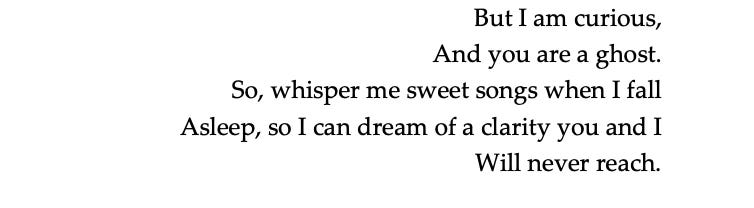
Still, I can remember X, with her curly brown hair and brown eyes as she was, before I could visualize the bigger picture with retrospect. I remember how she romanticized becoming a poet one day, being novel somehow.